
“How to Make an American Son”: Latino Dad vs. His Privileged Son—at NCTC

Richard Perez & Nicholas René Rodriguez. Photos by Lois Tema
Christopher Oscar Peña Casts Cringey Doubt on Immigrant Future
by Rachel Norby
A Honduran American dad seems to achieve the “American Dream.” He has worked his way up from poverty to owning his own office cleaning company. But his hard work has resulted in a spoiled, self-centered son. His son’s life is so foreign to him that they are strangers.
The set’s magnificent curved, dynamic glass walls thrust us into conflicting moods. Each color change flashes a new message: “Bills, Debt, Boys, Foreign, Time.” We have to construct the story as it flows by.
As the dad, Mando (deft Richard Perez) starts too late to impose rules on his son Orlando (skillful Nicholas René Rodriguez). Dad has accepted his gay soon, but discontent simmers. Rodriguez’s Orlando is snobbish, and downright unlikable.
“Being gay is expensive!” the 15-year-old quips when his father questions his credit card purchases, including an expensive leather Coach bag. Mando has instilled in Orlando that he can be whatever he wants to be, but private school and expensive clothes make Orlando comically selfish and arrogant.

Nicholas René Rodriguez & Matt Skinner
Based on his credit card bills, Orlando is out of control. Like a typical teen, he looks for love in all the wrong places. He has a crush on jock schoolmate Sean, played by Matt Skinner who shines as Orlando’s cocky crush. Sean’s muscles easily distract Orlando from his schoolmate’s crude sexual manipulation.
To help his son understand the value of the dollars he recklessly spends, Mando puts Orlando to work. As a janitor, he meets Rafael, a recent immigrant (impressive Caleb Andrew Cabrera). Even at work, Cabrera’s Rafael embodies elegance and grace under pressure.
Unlike Orlando, Rafael is grateful for an opportunity to work. Cabrera navigates Rafael’s emotional turbulence, slowly revealing his story of anti-gay prejudice. Though his lines are few, Cabrera brings depth to Rafael’s isolation.
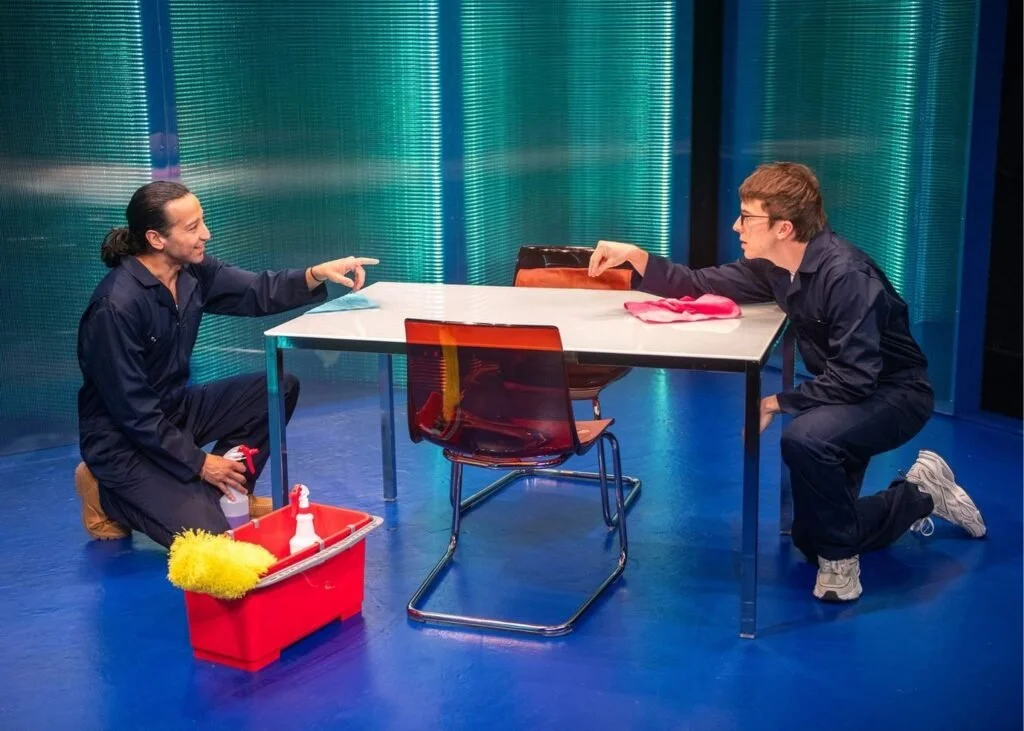
Caleb Andrew Cabrera & Nicholas René Rodriguez
Through admirable Rafael, we learn that Mando is not so gay-friendly. Although he puts up with Orlando’s sexual orientation, he still wants to control his son. Have his efforts to give Orlando everything turned both Mando and Orlando into pitiable personalities, less than themselves?
Mando’s subservience to the prejudiced snobs he works for threatens to destroy his life.
Elegant Monica Rose Slater plays Mondo’s office manager Mercedes, who hides her own needs to serve her boss. Slater’s pitch-perfect performance shows the dangers of exploited women in a male-dominated culture.
Peña’s dramedy uncovers the sacrifices each Latin immigrant makes in the U.S. They must please their employers or be threatened with deportation. In one explosive scene, Mando begs, pathetically, for a contract renewal from smarmy middle manager Dick (masterful Michael Phillis). As arrogant, corporate Dick, Phillis patronizes and debases Mondo in front of their sons, Sean and Orlando.
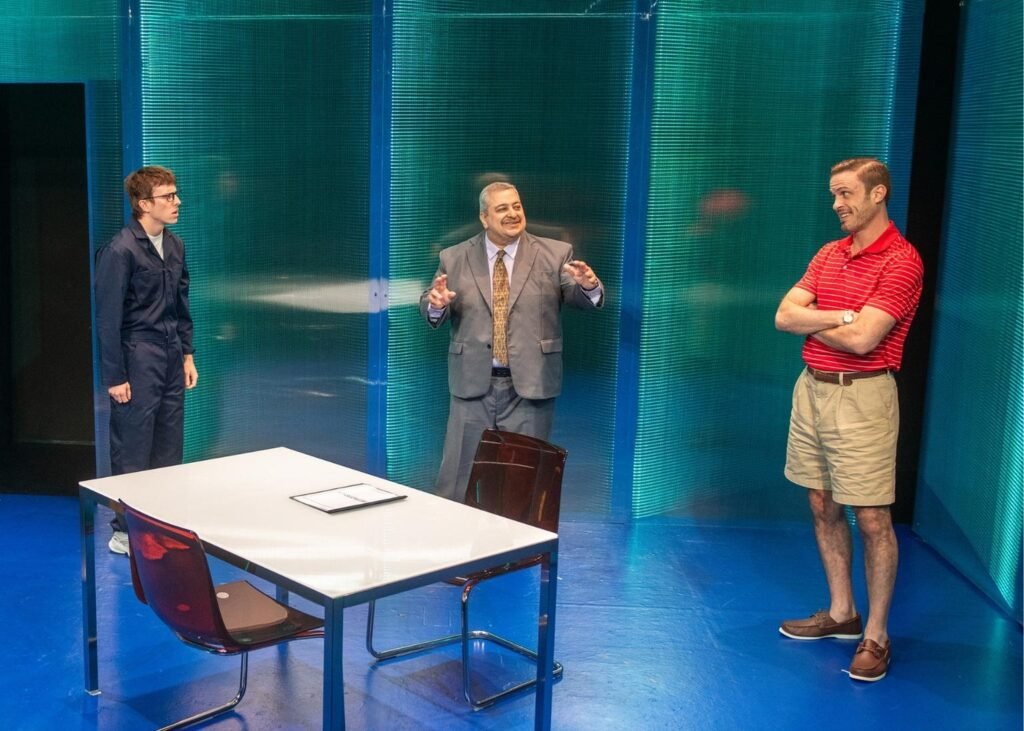
Nicholas René Rodriguez, Richard Perez, & Michael Phillis
Phillis’s polo-sporting Dick is wholly despicable, by far the cringiest character. Phillis channels unabashed human mediocrity brilliantly. If Orlando is unlikable, Dick is reprehensible.
“The Making of an American Son” evokes comedy, tragedy, and mystery. How can these daily class and racial conflicts be reconciled? The climax leaves us wondering at the cruelty of U.S. treatment of hard-working, honest immigrants. Peña’s abrupt ending shocks us into pondering our humanity.
“How to Make an American Son” by Christopher Oscar Peña, directed by Ben Villegas Randle, set & props by Maya Linke, lighting & projection by Spense Matubang, costumes by Alice Ruiz, and sound by Christopher Sauceda, at New Conservatory Theatre Center, San Francisco, California.
Info: nctcsf.org - to May 10, 2026.
Cast: Caleb Andrew Cabrera, Richard Perez, Michael Phillis, Monica Rose Slater, Nicholas René Rodriguez, and Matt Skinner.