“Public Charge” Proves Diplomacy Is Difficult & Worth Pursuing—at The Public
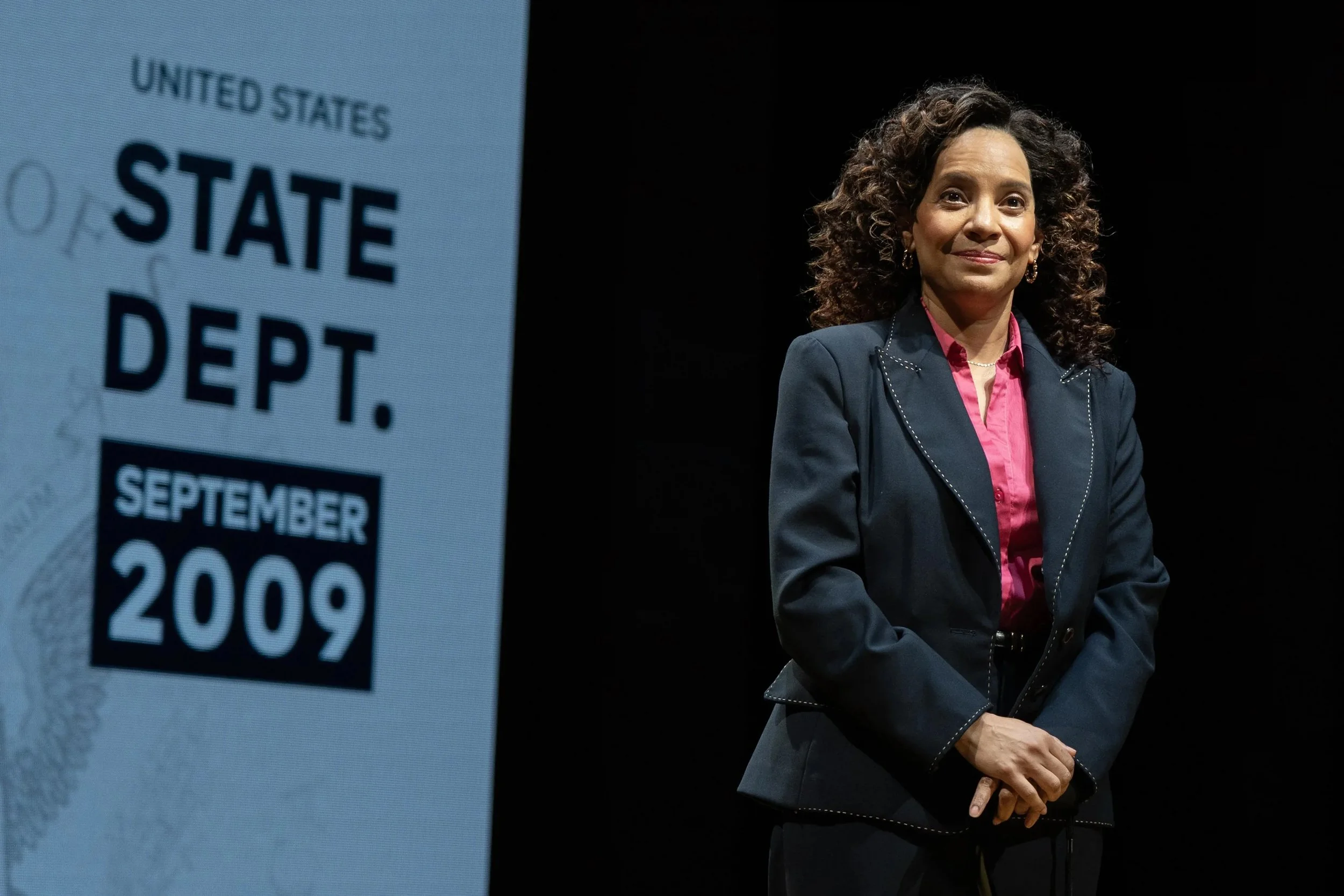
Zabryna Guevara. Photos by Joan Marcus.
Julissa Reynoso & Michael J. Chepiga Spotlight Government as Force for Good
by Andrea Libresco
“Public Charge” feels like the foreign policy companion to Michael Lewis’ Who is Government?: The Untold Story of Public Service. Lewis’ book celebrates committed, creative professionals in our government. They are the best of the best—a far cry from the current violence-prone “leader” and his chainsaw-wielding sidekick.
Our current regime has scorned diplomacy, starting with DOGE-ing USAID, a model of soft power. And now they are waging, unilaterally, a barely thought-out war against Iran. But the true story of Julissa Reynoso shows how government can work for us.
Reynoso and Michael J. Chepiga’s “Public Charge” performs the neat trick of presenting the diplomatic world of the Obama years, while contrasting that hopeful time with today’s darker world. The contrast takes place in our minds, raising a double consciousness like the double meaning of the play’s title.
“Public Charge” opens in 1981, at the US Embassy in the Dominican Republic, with 6-year-old, Spanish-speaking Julissa Reynoso being denied admission to the US. The consulate sees her as a probable drain on U.S. coffers.
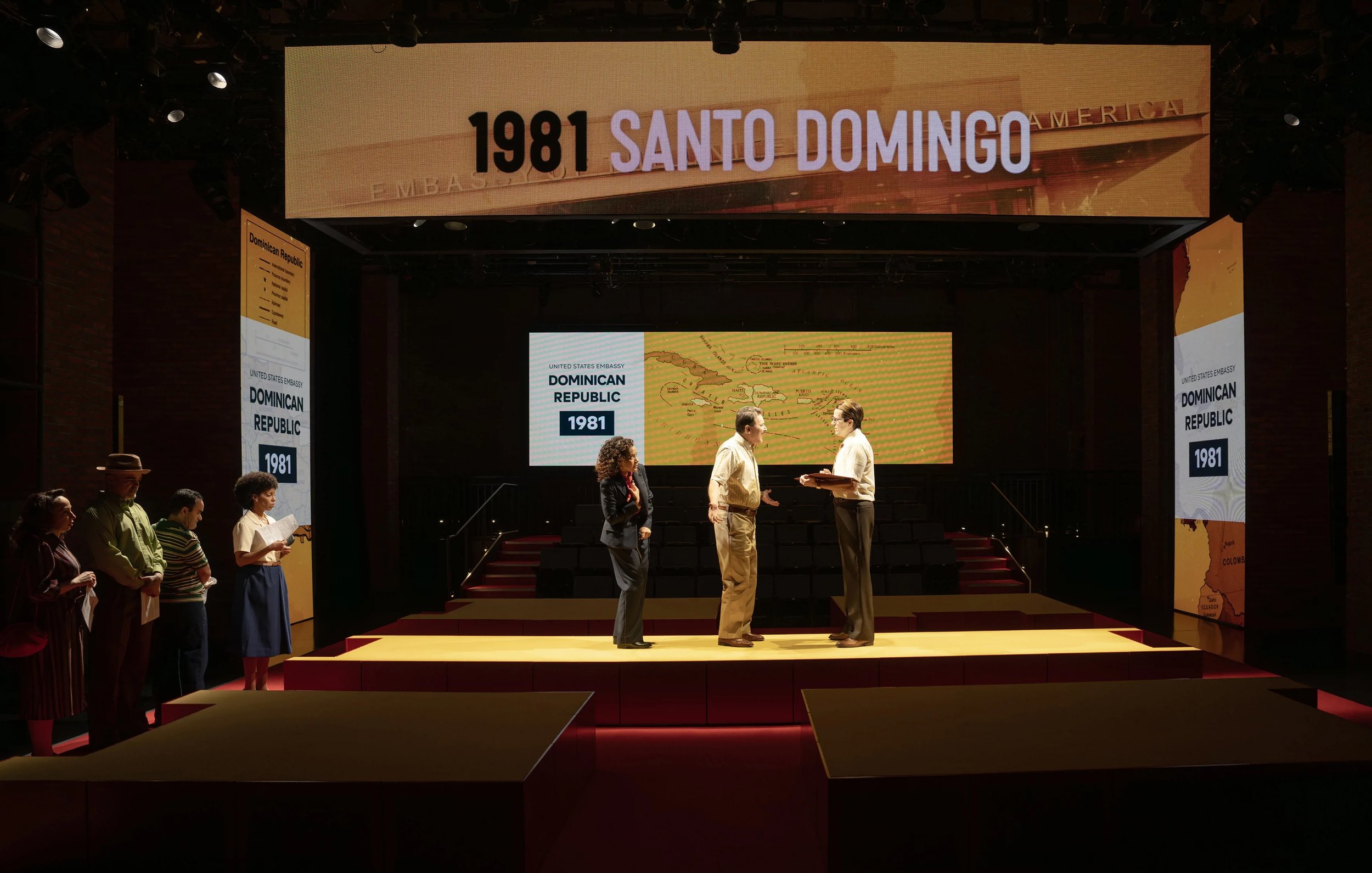
Zabryna Guevara, Al Rodrigo, John J. Concado
Fast forward to 2009, when Julissa is hired at President Obama’s State Department, encouraged to apply by Hillary Clinton. Julissa’s perfect English and Harvard education make her a brilliant hire. She becomes a diplomat who has a public charge to represent the U.S. in Latin America.
What if she had been permanently denied citizenship? We would never have had the benefit of a woman who left a high-paying law firm to serve her adopted country in public service.
“Public Charge” is not just an autobiographical tour of one woman’s work. Its narrative tension revolves around the quest to free American hostage Alan Gross. Can President Obama change half a century of hostile foreign policy toward Cuba?

Maggie Bofill and Al Rodrigo
The play charges forward, with diplomats constantly circulating. The audience sits on opposite sides, a staging that suits the ongoing encounters. Diplomats present subtle arguments to multiple stakeholders. Where is that art now?
As Julissa, sympathetic Zabryna Guevara engages with complex characters: the Cuban representative (wonderfully calculating Maggie Bofill), Julissa’s boss (strong Marinda Anderson), and the hostage’s wife (gripping Deirdre Madigan). Julissa has nightmares over the American hostage.
Admirably, Reynoso casts a colleague in the most nuanced role. Ricardo Zuniga (Dan Domingues) plays a powerful diplomat who served several presidents. Zuniga remains when Reynoso leaves; but he has been touched by her idealism.
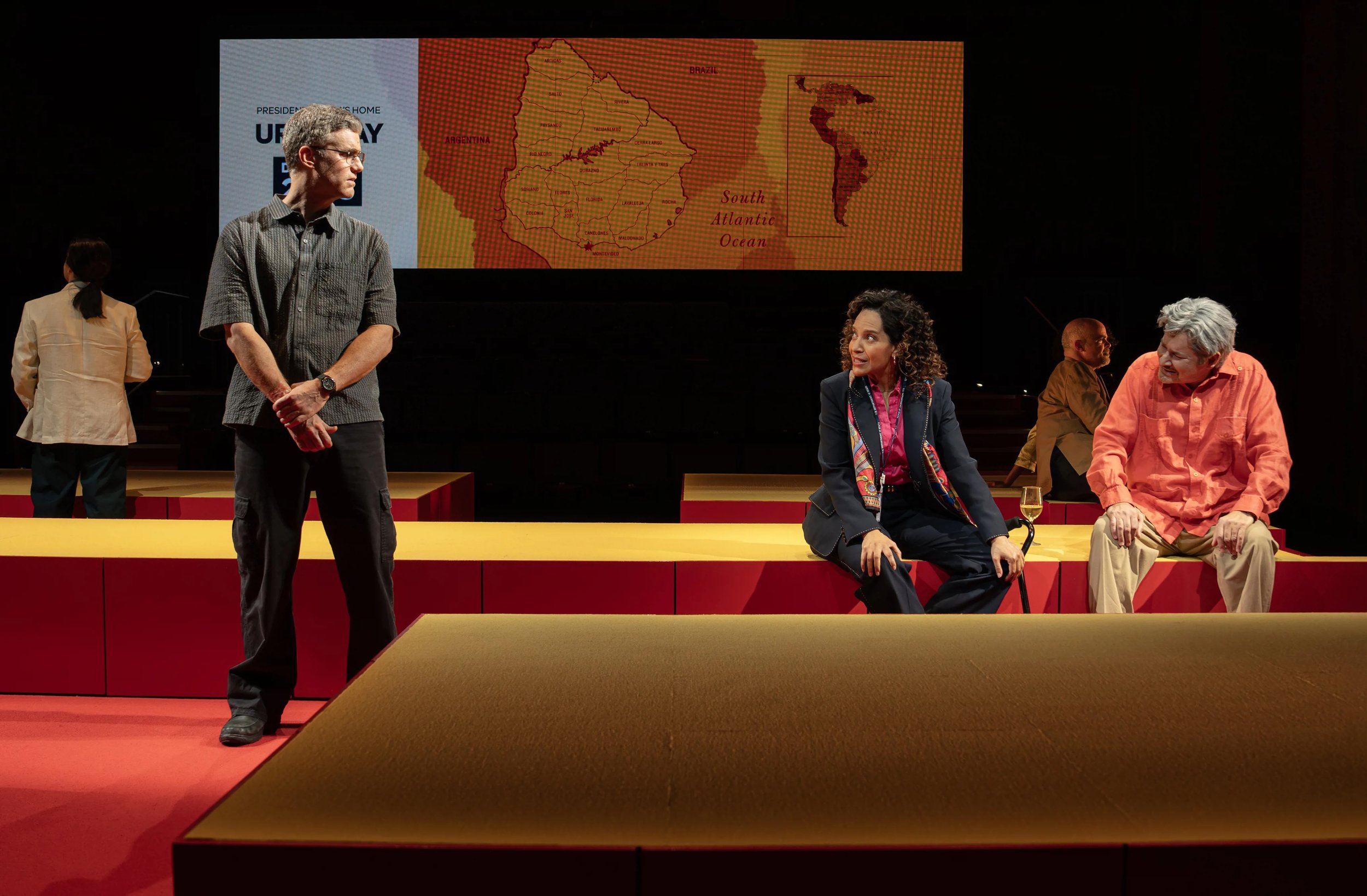
Armadno Riesco, Zabryna Guevara, and Al Rodrigo
Again, our double consciousness: these civil servants serve country, not leader. How can they operate today with a president who demands loyalty to himself over country?
Diplomacy is necessary. Diplomacy has multiple actors. Diplomacy requires patience and persistence.
The end of the play ought to be a triumph; Cuba has released the hostage at long last. And yet, we feel anything but release. Alan Gross spent five long years in a Cuban prison, separated from his wife.
Julissa believes “things are falling into place,” as she anticipates that Secretary of State Hillary Clinton will be the first woman president: “We are going to be the most progressive, inclusive country in the world. The best is yet to come.”
Sadly, we know better. For us, the ending is brutal.
“Public Charge” by Julissa Reynoso & Michael J. Chepiga, directed by Doug Hughes, scenic design by Arnulfo Maldonado, costumes by Haydee Zelideth, lighting by Ben Stanton, and sound by David Van Tieghem, at The Public Theater, New York.
Info: publictheater.org - to April 12, 2026.
Cast: Marinda Anderson, Nate Betancourt, Maggie Bofill, John J. Concado, Dan Domingues, Zabryna Guevara, Yesenia Iglesias, Paco Lozano, Deirdre Madigan, Nairoby Otero, Armanda Reisco, and Al Rodrigo.