
“Jesa”: Sisters’ Reunion Goes Inevitably Awry—at The Public
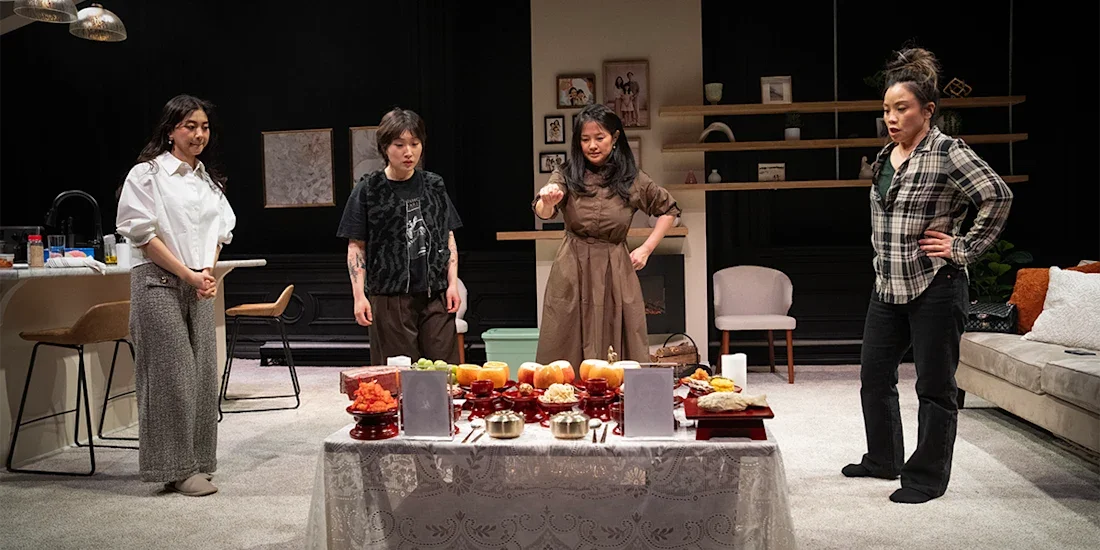
Laura Sohn, Christine Heesun Hwang, Shannon Tyo, Tina Chilip. Photos: Joan Marcus
Jeena Yi Digs Deep into Korean Family Secrets & Finds Humor
by Andea Libresco
Beige is the dominant color of one sister’s Orange County home, and the setting for Jeena Yi’s play, but the goings-on will hardly be beige. Indeed, those kitchen knives lined up perfectly on their magnetic wall holder will get some use!
Four Korean American sisters gather for Jesa, an annual Korean ceremony to honor their dead mother and father and ask for their blessings. As traditional food is arranged and consumed, old animosities surface, secrets are revealed, ghosts visit, and emotions are expressed and expressed and expressed.
The sisters, like many siblings, do not appear to have much in common. Tina (Tina Chilip), the oldest, has a big laugh and a foul mouth. Grace (Shannon Tyo), second oldest, hosts them in her suburban home.
The third sister, struggling theater director Brenda (genuine Christine Heesun Hwang), has avoided attending the ceremony for years. And youngest sister Liz (Laura Sohn) has enough money from her job in finance to set up a trust for Grace’s daughter.
Playwright Jeena Yi encapsulates the sisters’ differences in small actions, like how they take off their shoes: Grace, the “perfect” host, wears indoor sandals, while Tina kicks off her boots, sending them flying. Liz lines up her shoes just so; Brenda forgets to remove hers and, later, reveals no socks.
But the sisters share a heavy burden: the trauma of being raised in a household marked by their Korean parents’ anger, which, we learn, included physical abuse.
The Jesa ritual, centerpiece of the play, is beautifully realized with traditional food–grapes, chestnuts, shrimp, rice, oranges. They bow together, capturing the stillness and respect of the ancient ceremony.
When none of the sisters can recall the precise order of the rite, Liz googles “Jesa,” but the sites are all in Korean, which they cannot read. Playwright Yi presents their second-generation immigrant struggle simultaneously as comedy.
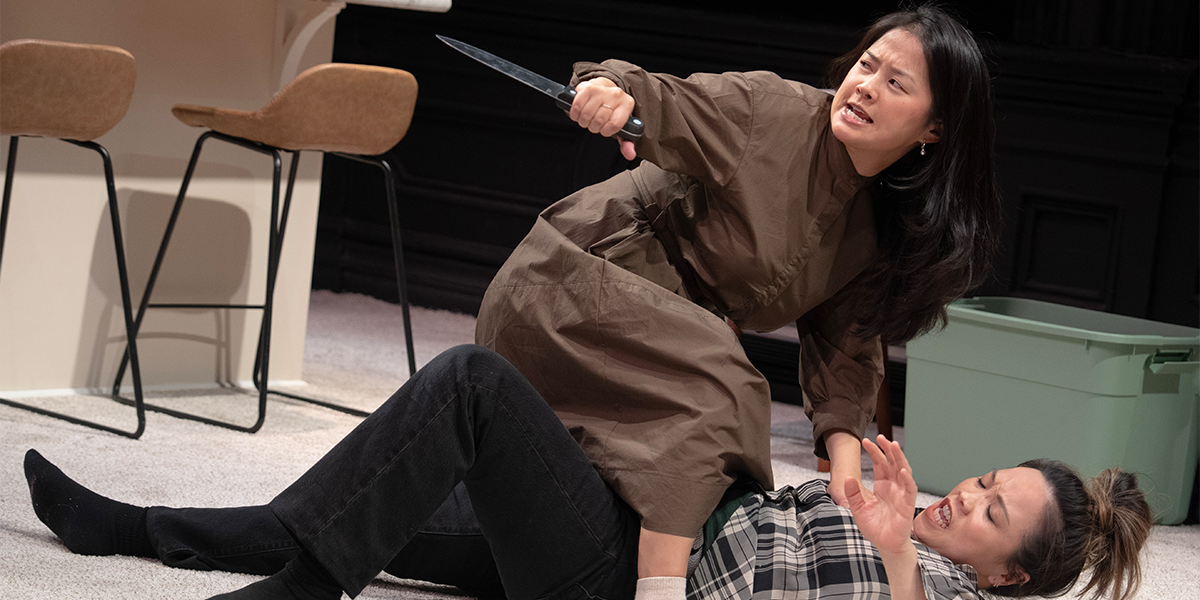
The knife comes out . . .
Over the course of the evening, as a physical fight breaks out, the shrimp is burned, the tablecloth is pulled off the ceremonial altar, and the electric candles are knocked over. Humor arrives at just the right moment: “This is why we don’t have real candles.”
All is recovered: sisters salvage the shrimp, the candles, and the altar. The ritual resumes, so that even the skeptical can acknowledge their parents’ spirits and transgressions. But the generational trauma remains. As she reflects on her own DUI and firing from her job, Liz speaks to her father’s photo, saying: “apple, tree.”
This Jesa provokes powerful changes. At the end, we find ourselves hoping that, by naming their trauma and admitting their imperfections, the sisters can move forward. A younger sister finally calls her older sister “Unnie,” the Korean term of respect.
One sister reassures another that her daughter will forgive her because she forgives their mother. Another asks the sister with the once-orderly beige house: “My far-from-perfect confused, loved sister, your whole life is waiting for you; what are you waiting for?”
The sisters are free to plan their next, less haunted, Jesa … in Vegas.
“Jesa” by Jeena Yi, directed by Mei Ann Teo, scenic design by You-Shin Chen, costumes by Mel Ng, lighting by Jeanette Oi-Suk Yew, andsound by Hao Bai, by Ma-Yi Theater Company, at The Public Theater, New York.
Info: publictheater.org - to April 12, 2026.
Cast: Tina Chilip, Christine Heesun Hwang, Laura Sohn, and Shannon Tyo.