
“Antigone (This Play I Read in High School)” Transforms Tragedy—at the Public

Susannah Perkins & Calvin Leon Smith. Photos: Joan Marcus
Anna Ziegler Re-Imagines Woman vs. State, Brilliantly!
by Andrea Libresco & Mary Cushman
Before the lights go down, we see a girl lying on a couch with a fierce shag haircut, wearing Doc Martens and revealing a tattoo on her thigh. We know that this will not be the “Antigone” we read in high school.
The costumes, set, and dialogue are in present-day style, providing witness to the strictures imposed on women’s bodies under patriarchal authoritarian rule, then and now.
The ensemble is outstanding, from classical heroes, to comical cops, and an abortion provider—all pitch perfect.
In the Greek tragedy, Antigone (gripping Susannah Perkins) defies her uncle, King Creon, by giving her brother a proper burial. In Anna Ziegler’s new version, pregnant teenager Antigone undergoes an abortion, which Creon has ruled punishable by death.
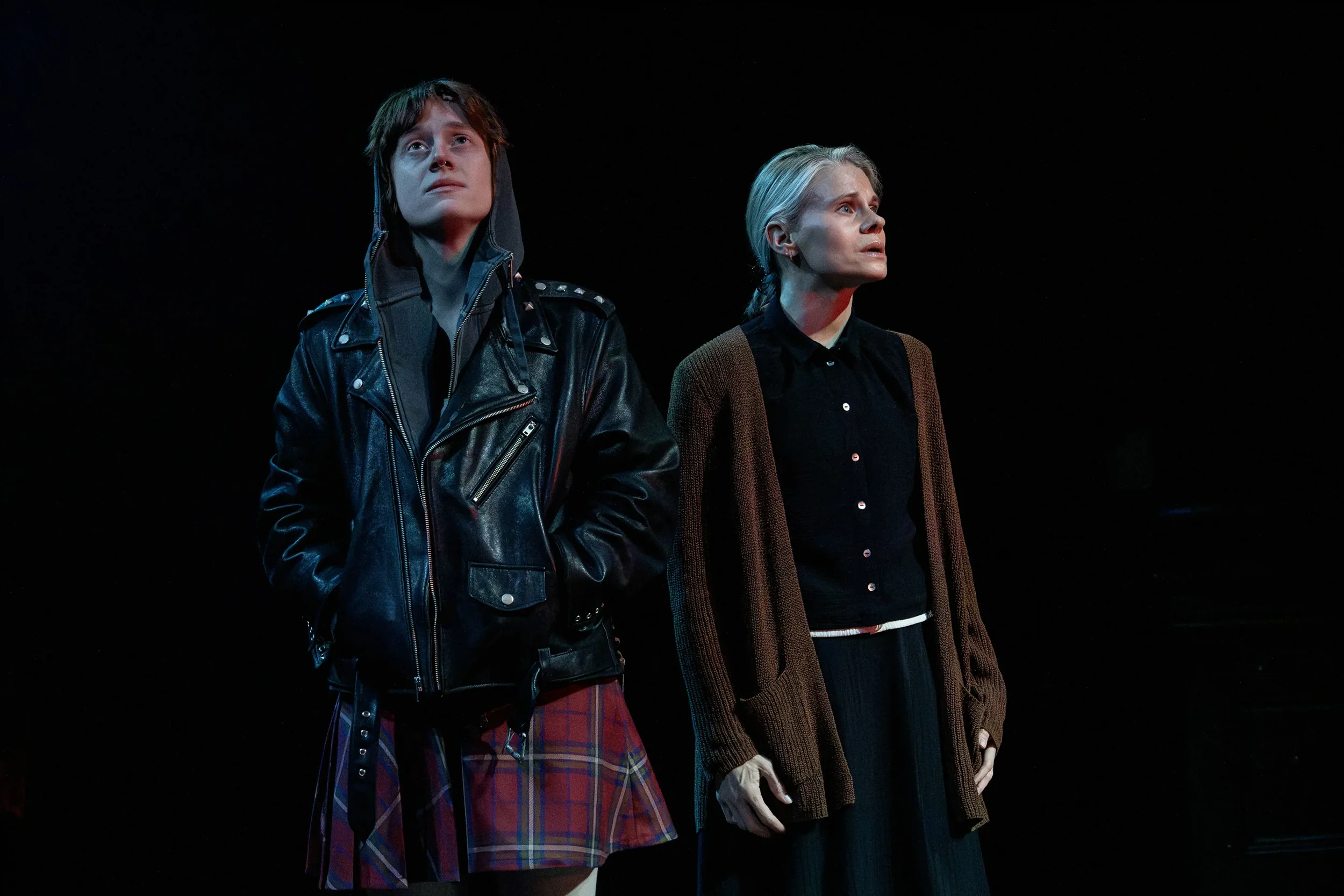
Susannah Perkins & Celia Keenan-Bolger
When Antigone refuses to apologize for defying the law, Ziegler reproduces the age-old conflict: individual conscience vs. state authority, a woman’s body vs. body of the state.
Playing Chorus/Narrator, Celia Keenan-Bolger tells us that a play she read in high school keeps popping up in her life. Marvelous in the role, Keenan-Bolger is amusing and self-effacing. This Chorus chats with us throughout the action, updating us about her awe at Antigone’s daring.
The action begins with Antigone sitting next to Chorus on an airplane and reading, yes, “Antigone.” Perkins’ is fearless, funny, and outspoken. What a contrast to King Creon, her uncle, a wonderfully nuanced Tony Shalhoub.
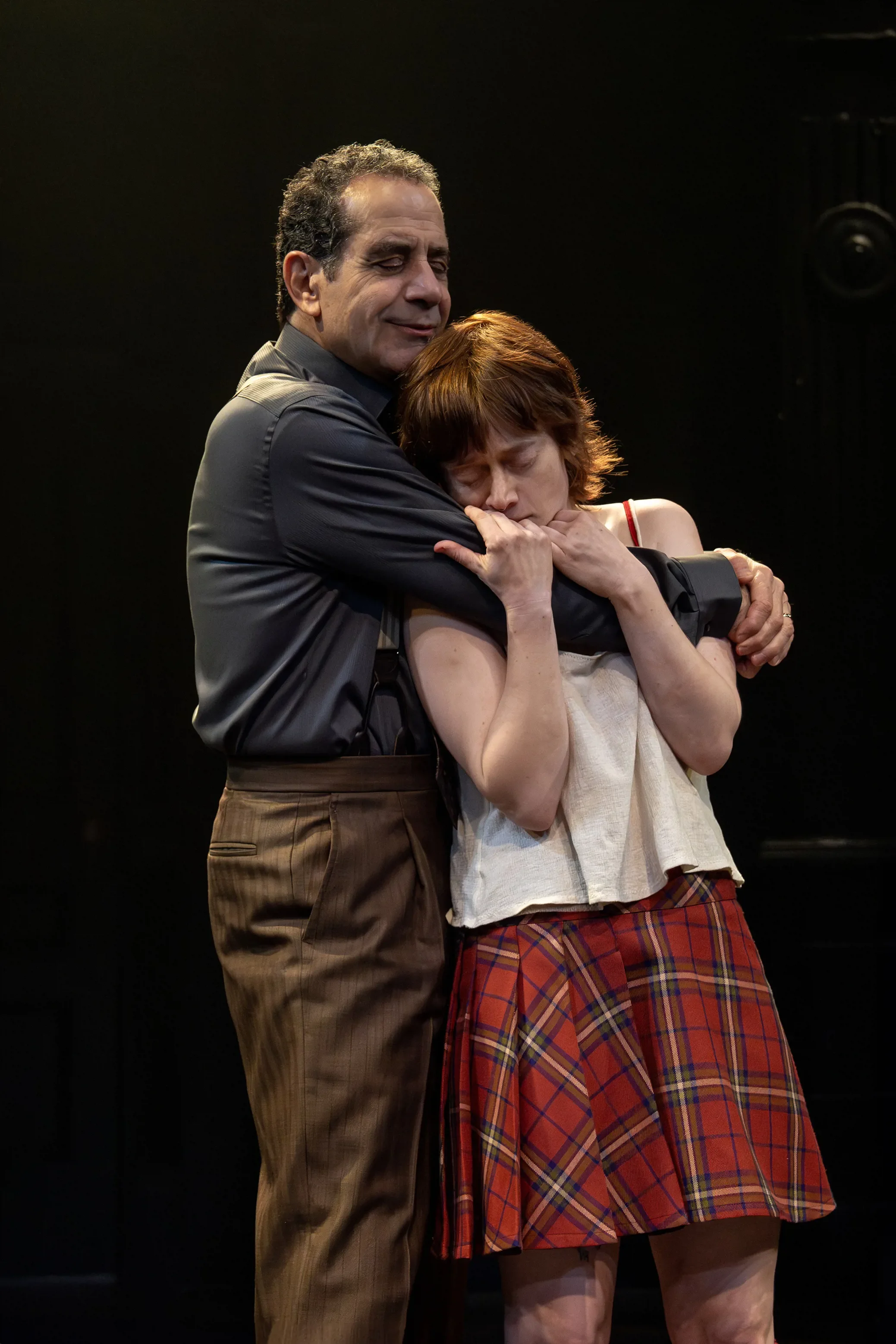
Tony Shalhoub & Susannah Perkins
Shalhoub’s king gains our sympathy because he starts as a reluctant leader. He believes in the power of laws which “turn feckless noise into an orchestra.” He understands that governing is hard. Creon longs for order.
The playbook of an autocrat is clear: lay down the laws and punishments in hours-long speeches, manipulate crowds, manufacture reality, and enforce “security.” The police and guards provide frequent comic touches to lighten the tragic plot, including accents and a recurring bit with a slowly falling sheaf of legal papers.
But the guards still carry out the leader’s law. After all, Creon reasons, “If I can’t control my own niece, I can’t be trusted with a city.”
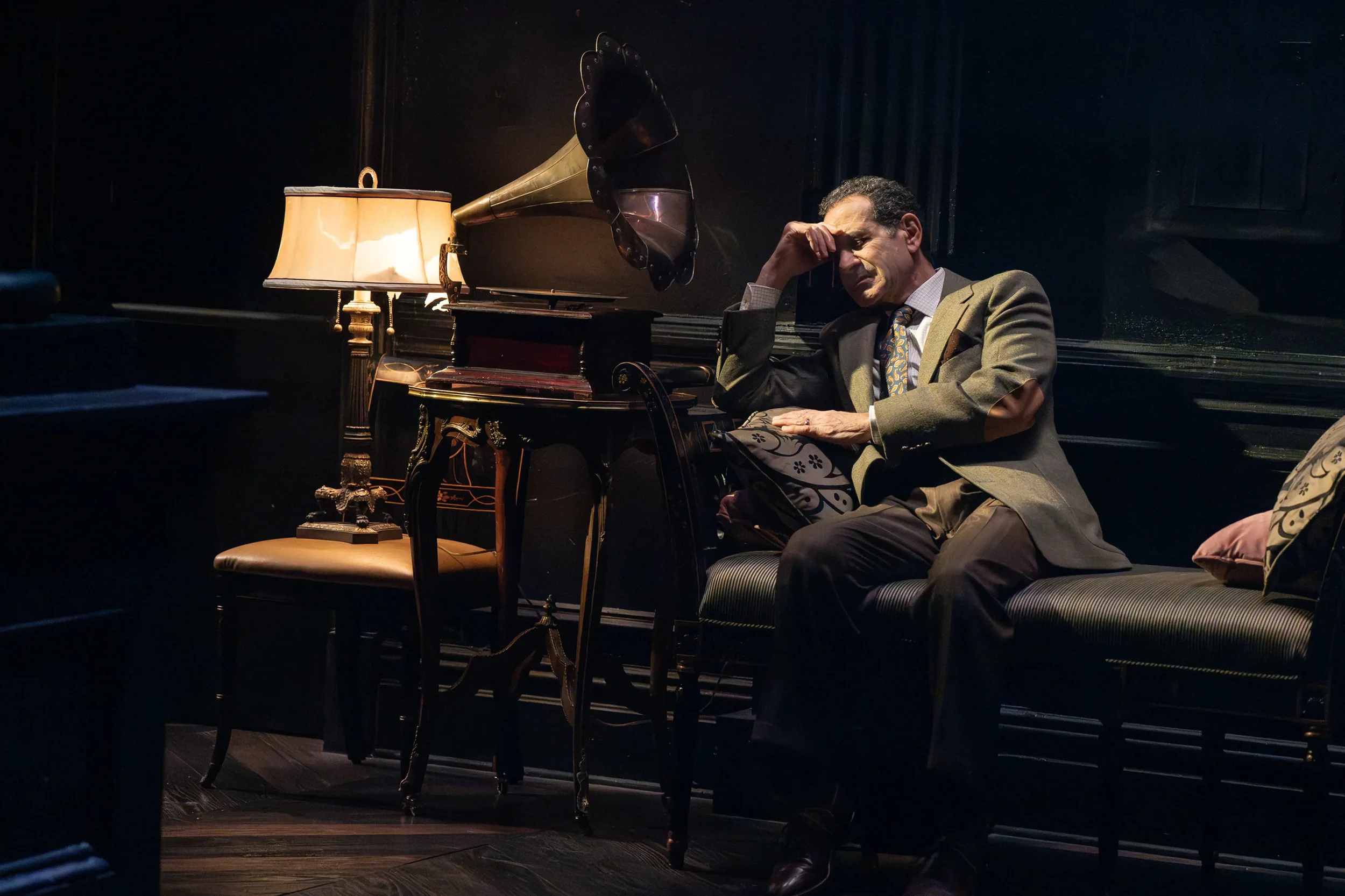
Tony Shaloub. Photos by Joan Marcus
In a climactic post-abortion scene, the newly empowered Antigone confronts her agitated uncle with her bodily autonomy. Antigone slowly removes her clothing while describing details—from a small facial scar to her bloody undershorts. She refuses to apologize for her messy woman’s body that bleeds.
Creon cannot control Antigone. Nor can he control the crowd, whose cacophony steadily increases, as bits of ceiling plaster drop to the floor. The autocrat’s world is literally falling around him.
Antigone and Creon are still worthy opponents. The age-old debate has come home. Both “My body, my choice” and “Uphold the rule of law” signs appear at today’s protest marches. We must ask who makes the laws, and do they serve all citizens or only certain ones? As Antigone asserts: “If there can’t be fair laws, let there be no laws at all.”
The present-day Narrator gets the last words, reminding us that, though this thrilling play must close, Antigone is “anti-gone.” She will not be erased. Nor will the Narrator. Nor will all women.
“Antigone (This Play I Read in High School)” by Anna Ziegler, directed by Tyne Rafaeli, scenic design by David Zinn, costumes by Enver Chakartash, andlighting by Jen Schriever, at The Public Theater, New York.
Info: publictheater.org - to April 5, 2026.
Cast: Raquel Chavez, Ethan Dubin, Celia Keenan-Bolger, Katie Kreisler, Susannah Perkins, Dave Quay, Tony Shalhoub, Calvin Leon Smith, and Haley Wong.