
“Ulysses”: A Thrilling Meditation on Humanity—at The Public
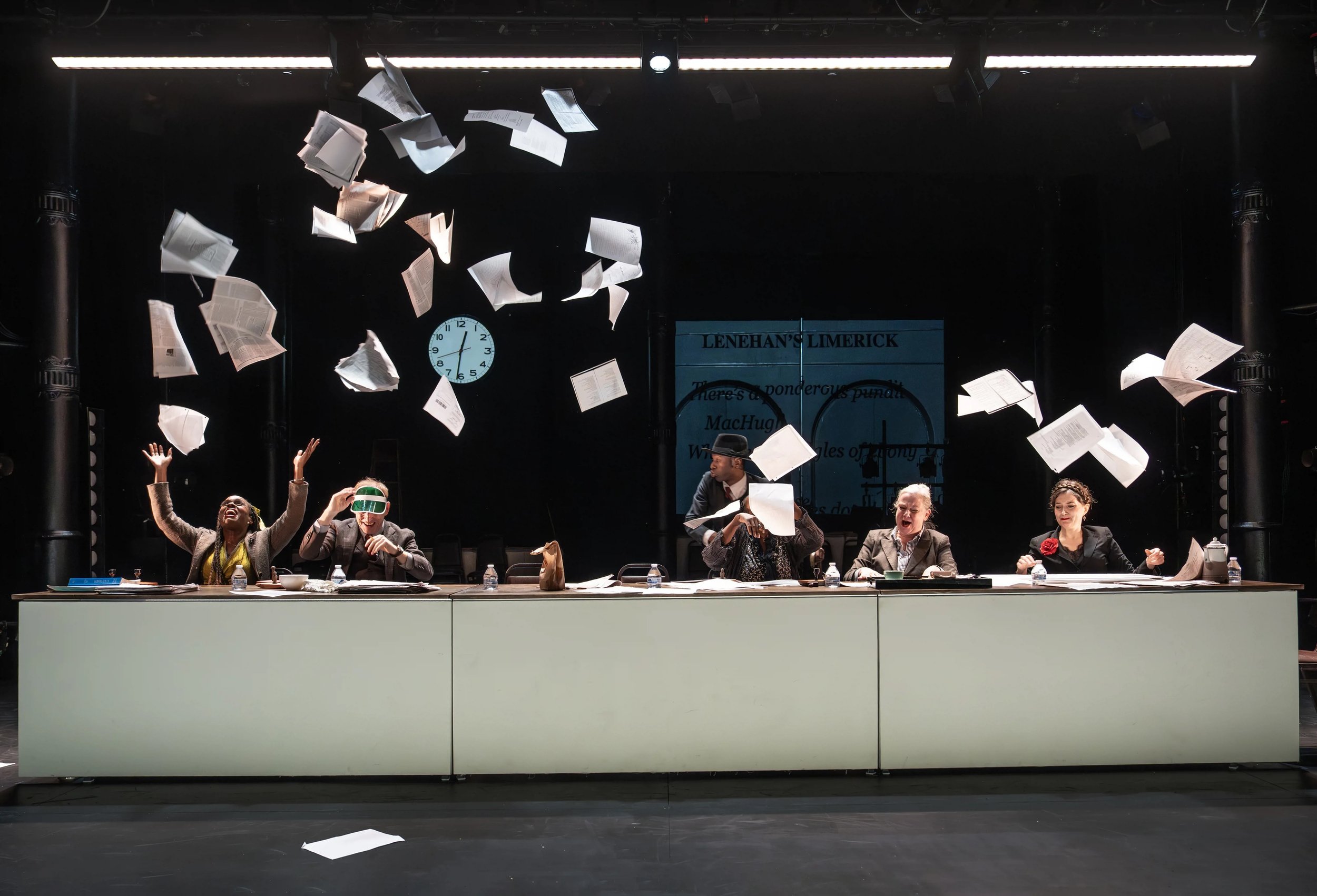
The company of Elevator Repair Service’s “Ulysses.” Photos by Joan Marcus
Elevator Repair Service Stages Joyce’s Ulysses Brilliantly
by David Moore
At The Public Theater, I saw something impossible: Elevator Repair Service has adapted James Joyce's novel Ulysses in a gripping and exciting play in under three hours. Onstage, the supposedly unfathomable novel suddenly becomes visceral fun. The brilliant ensemble, led by Vin Knight and Maggie Hoffman as Leopold and Molly Bloom, transports us to a special and not-so-special Thursday in Dublin in 1904.
The set looks stark and ominous: on a dark stage, seven metal chairs behind desks become daring evocations of Joyce's overflowing Dublin life. The actors transform simplicity into a vibrant, living world, speaking with modern rhythms.
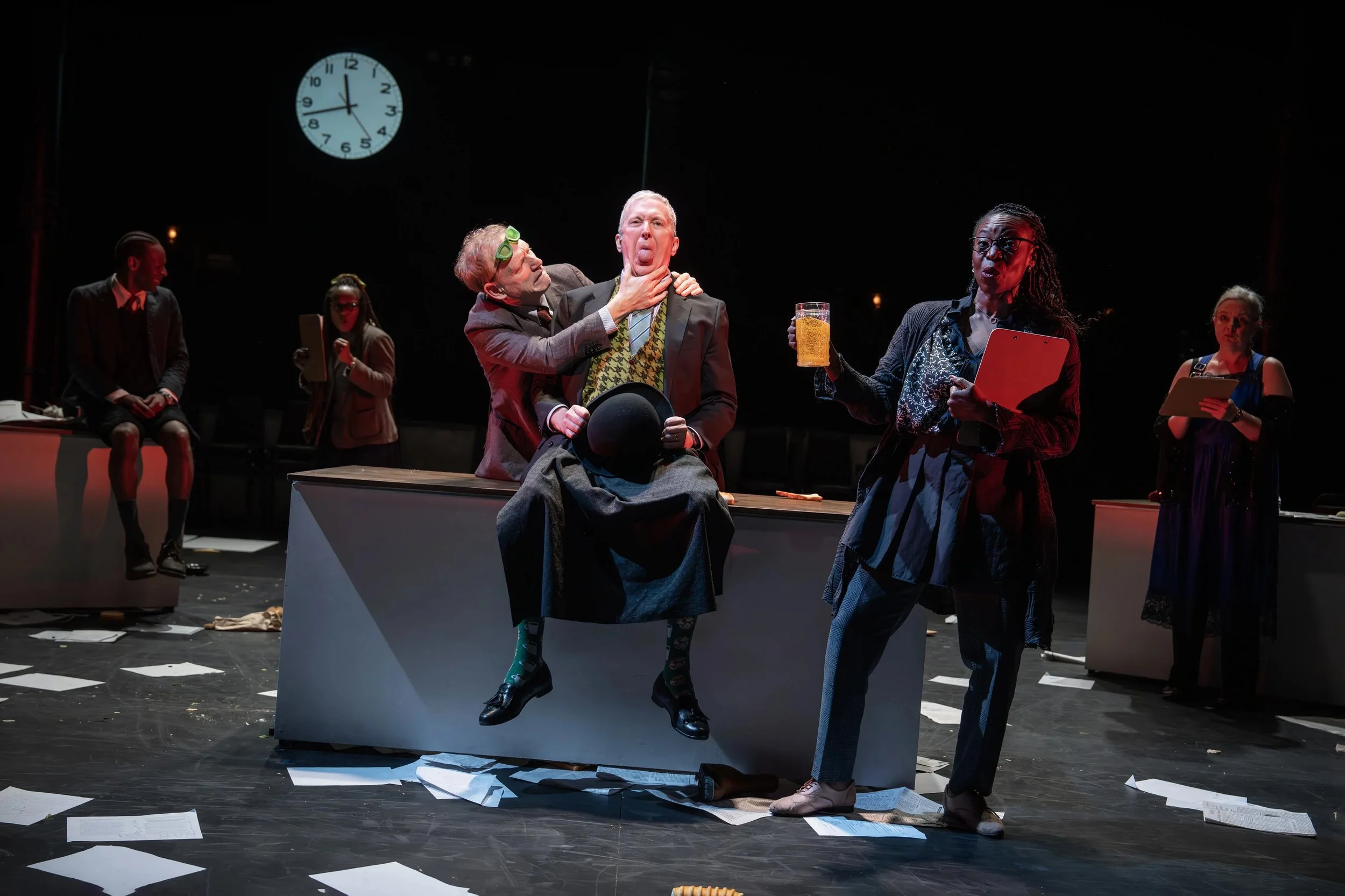
Christopher-Rashee Stevenson, Stephanie Weeks, Scott Shepherd, Vin Knight, Dee Beasnael, and Kate Benson
Scenic Designer “Dots” does everything with almost nothing. Props are introduced strategically: first, a ceramic shaving bowl, then the dirty "snot green" handkerchief. As the play progresses, props define the scenes: fig cookies, a cane, blankets, and pillows, lavish plates of cabbage, and tankards of beer. The objects evoke Joyce's unforgettable Dublin: a printing press, a beach, a Turkish bath, a funeral, and a noisy restaurant.
The actors guide us through Joyce's poetic prose, experiencing it with us the words unroll on a large screen. As the Narrator, Scott Shepherd steps out to introduce episodes and illuminate the story with seductive wit and warmth.
The actors move fluidly between multiple roles: Dee Beasnael shifts from Armstrong to Milly Bloom to Martin Cunningham; Kate Benson slips from Haines to Simon Dedalus to The Citizen. Thanks to Enver Chakartash's clever costumes and the skillful actors, each scene rises and flows effortlessly forward.
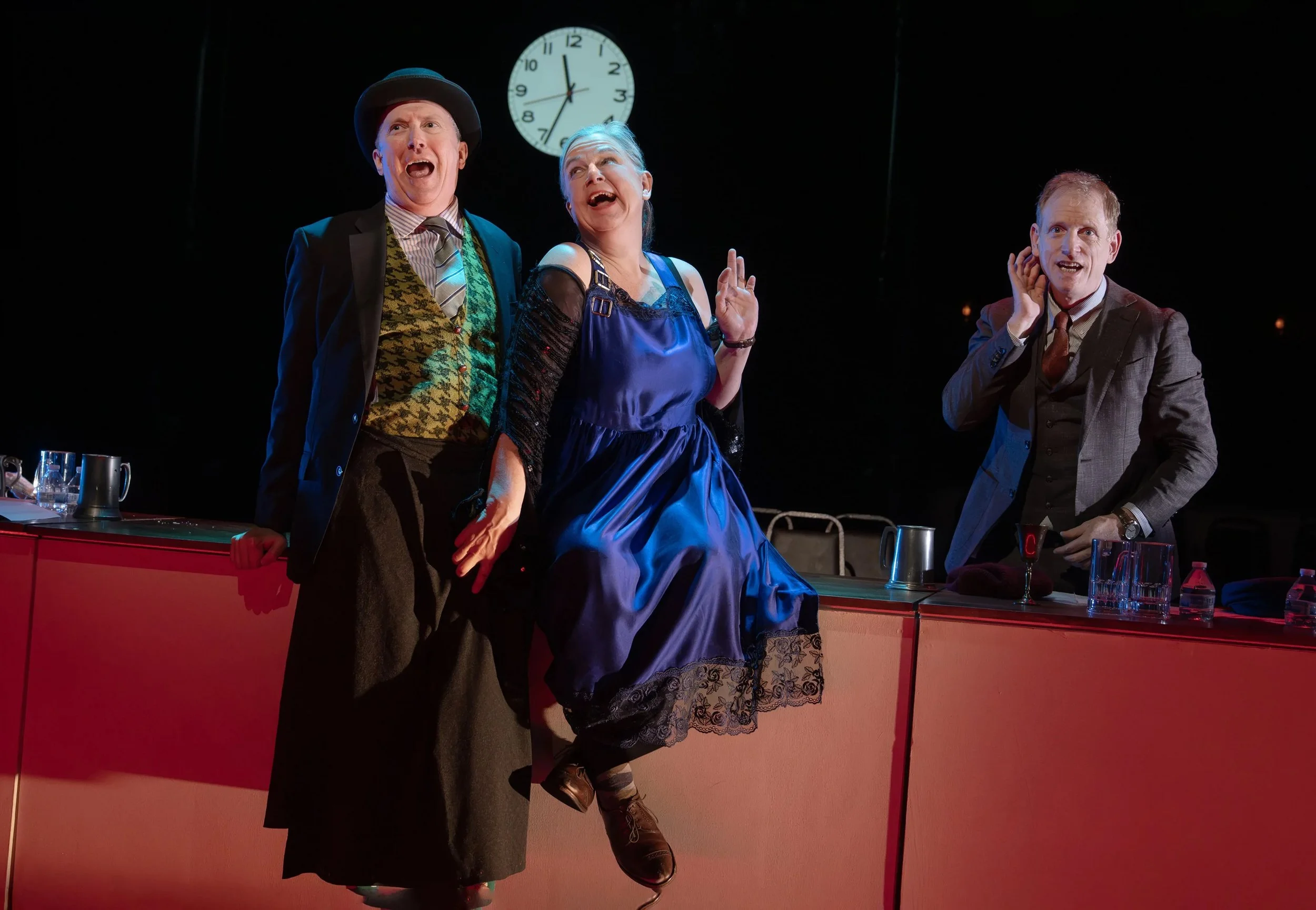
Vin Knight, Kate Benson, and Scott Shepherd
ERS’s most delightful device appears when they skip an episode from the novel: the projected text races forward with the sound of a fast-forwarding tape cassette. And the actors are thrown back like roller coaster passengers. In one hilarious moment, Vin Knight's Leopold Bloom rapidly puffs his cigar, smoking in fast-forward. We laughed out loud at the glorious actors expressing themselves with calculated irreverence.
Ben Williams' brilliant sound design provides scaffolding for our imaginations. As Stephen Dedalus gazes at the ocean, we are transported by the sounds of waves and boots on crunching seashells. The printing press crackles with mechanical clacking. The restaurant buzzes with conversation and clinking plates. We are inside Dublin’s heart.
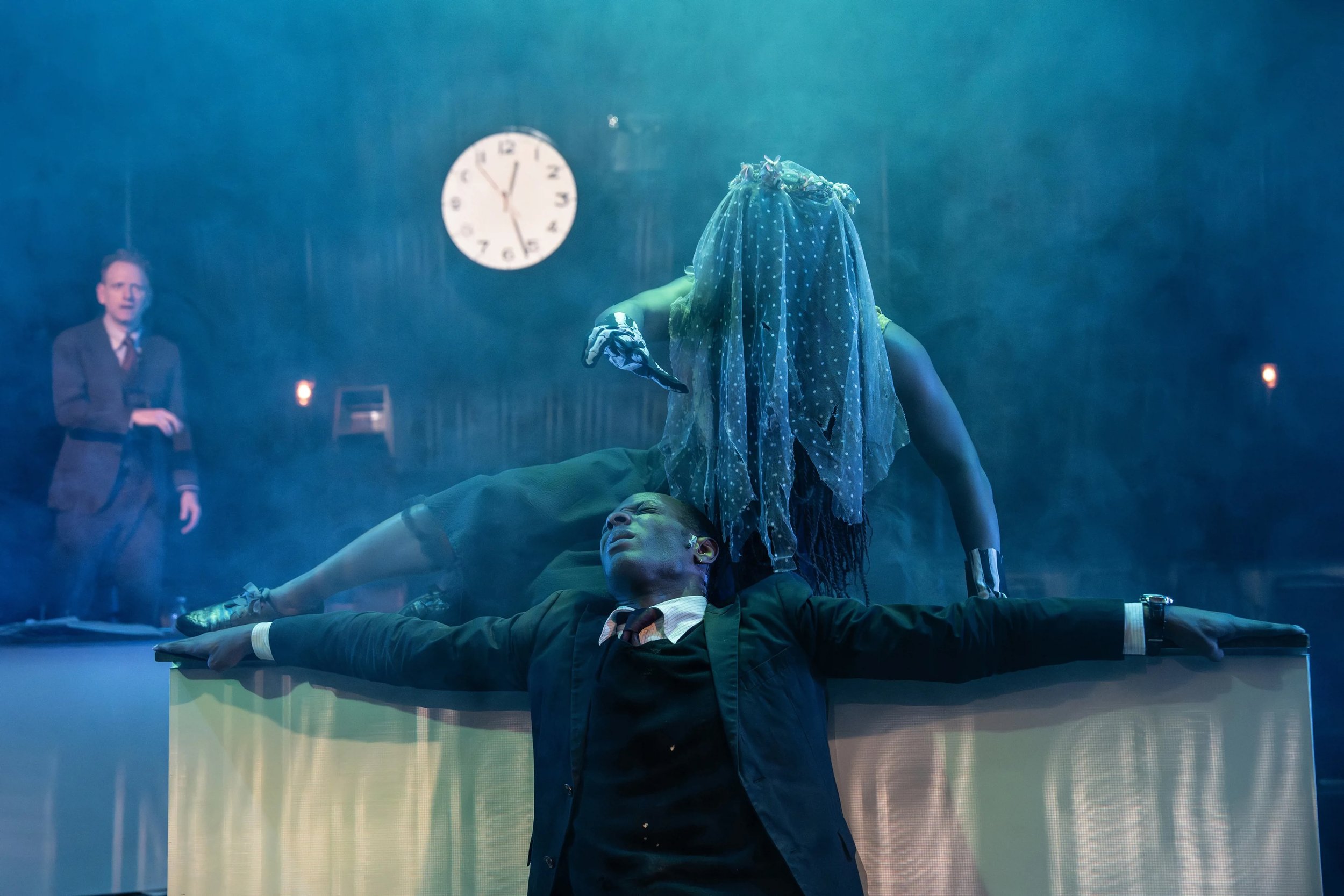
Scott Shepherd, Stephanie Weeks, and Christopher-Rashee Stevenson
But “Ulysses” is also about loss. Leopold and Molly are grieving their son, who died before age eleven. They stopped having sex since his death. A paradox looms: "Nothing happens except for everything." It's one day in a man's life: he eats lunch, takes a bath, smokes a cigar. Alongside these small moments inescapable grief and erotic desire press closer.
The play refuses to shy away from frank sexuality. It’s all there—Leopold's voyeurism and his masturbation. Maggie Hoffman's startlingly intimate performance of Molly's final monologue celebrates the body's pleasures and humiliations unflinchingly. Hoffman draws us into a magnificent meditation on humanity itself.
Elevator Repair Service cracks the code of Ulysses with their unique formula. The ensemble provides sheer theatrical magic to unlock Joyce’s wonders. Their dazzling stagecraft encourages us to participate rather than merely consume. The impossible becomes the unforgettable. In the words of Molly Bloom: “… and yes I said yes I will Yes.”
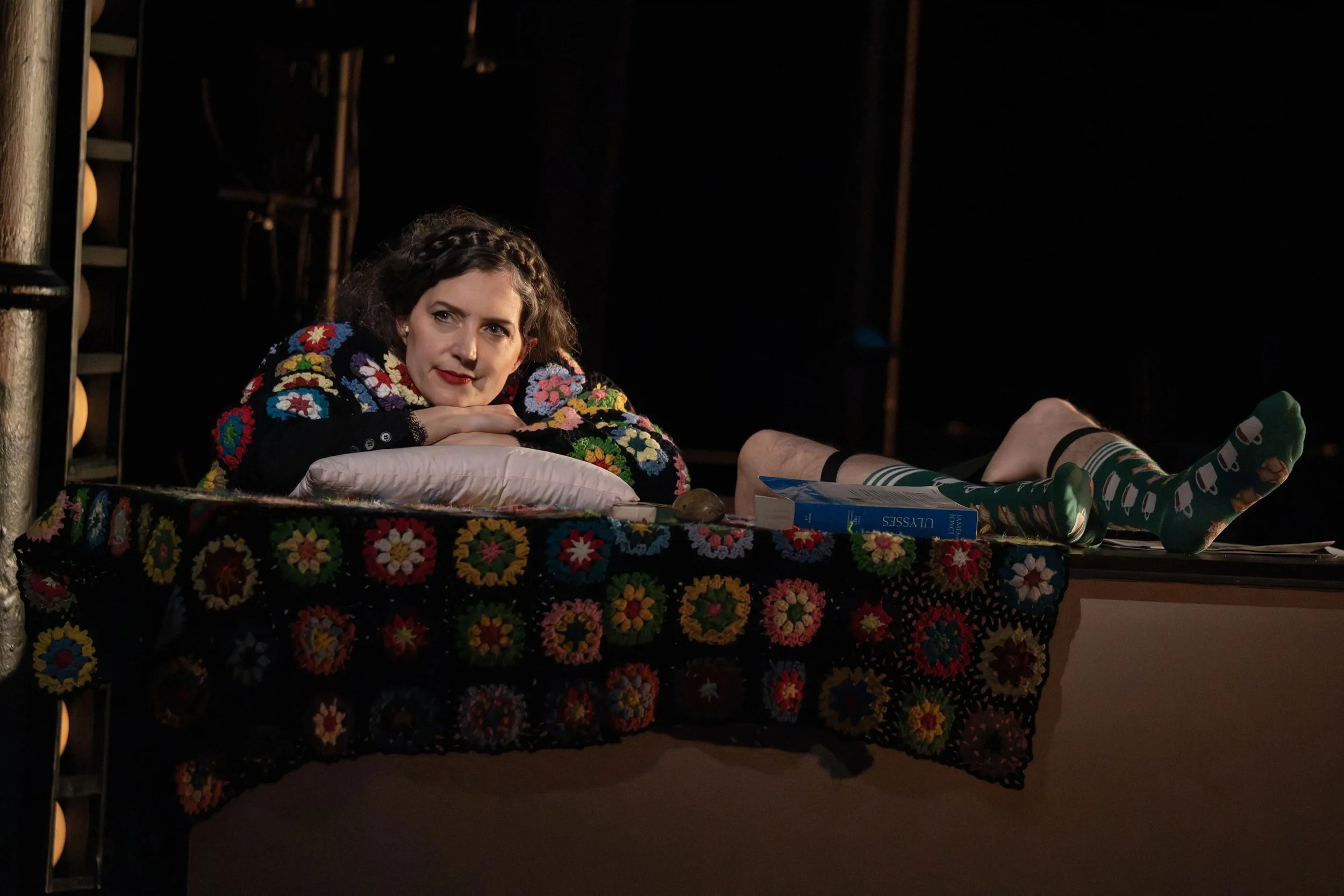
Maggie Hoffman
"Ulysses" –created by Elevator Repair Service, text of Ulysses by James Joyce, co-direction & dramaturgy by Scott Shepherd, directed by John Collins, at The Public Theater, New York.
Scenic design by Dots, costumes by Enver Chakartash, lighting by Marika Kent, sound by Ben Williams, projections by Matthew Deinhart, and props by Patricia Marjorie.
Info: publictheater.org - to March 1, 2026
Cast: Dee Beasnael, Kate Benson, Maggie Hoffman, Vin Knight, Scott Shepherd, Christopher-Rashee Stevenson, and Stephanie Weeks.